Ohio Computer Academy - IT Training & Vocational Education in Dublin, OH
All Courses
  • Free Training Courses
  • AI for Your Role
  • AI & Machine Learning
  • Cloud Tech
  • Data Science
  • DevOps
  • Dashboarding/BI
  • Database
  • WebDevelopment
  • Programming & Coding
  • MS Office & Workplace Productivity
  • QA & Test Automation
  • Professional & Career Development
  • Cyber Security

Courses

  • Computer Fundamentals for Beginners
  • MS Word for Beginners
  • Microsoft Excel for Beginners
  • Microsoft Azure for Beginners
  • AWS Cloud for Beginners
  • Oracle SQL Fundamentals
  • Tableau Fundamentals
  • Power BI Fundamentals
Explore All Programs

Courses

  • AI Essentials
  • AI for Administrative Professionals New Launch
  • AI for Managers & Team Leads
  • AI for Data Analytics & Power BI
  • AI for Software Developers
  • AI for Database & SQL Professionals
  • AI for Project Managers
  • AI for Marketing Professionals
  • AI for Sales Professionals
  • AI for HR Professionals
  • AI for Finance Professionals
  • AI for Customer Support Professionals
  • AI for QA & Test Engineers
  • AI for IT Support & System Admins
  • AI for Cybersecurity Analysts
  • AI for Job Seekers
Explore All Programs

Courses

  • Learn Claude Basics New Launch
  • Learn Claude Advanced New Launch
  • Applied Artificial Intelligence (AI) New Launch
  • AI for Workplace Productivity
  • Azure Fundamentals with AI
  • Advanced Microsoft Azure with AI
  • AI Implications for Business Strategy
  • Mastering ChatGPT & Generative AI Tools
  • Prompt Engineering
  • Agentic AI Solutions
  • AI Product Management
  • AI for Quality Control
Explore All Programs

Courses

  • AZ-900 Azure Fundamentals
  • DP-900 Azure Data Fundamentals
  • DP-100 Data Science on Azure
  • AWS Essentials
  • AWS Cloud Practitioner
  • AWS Solutions Architect
Explore All Programs

Courses

  • DP-100 Data Science on Azure
Explore All Programs

Courses

  • DevOps Essentials
  • DevOps with AWS
  • DevOps with Azure
Explore All Programs

Courses

  • Business Analytics: From Data to Insights New Launch
  • Power BI Advanced
  • Data Analytics with Excel
  • Tableau Beginner
  • Tableau Data Consumer
  • Alteryx & Tableau
  • Tableau Advanced
  • Tableau Certification prep
  • Power BI Beginner
  • Cognos Analytics
Explore All Programs

Courses

  • SQL Server for Beginners
  • SQL for Analysts
  • SQL Server Advanced
  • SQL Server T-SQL Programming
  • SSIS
  • Oracle SQL for Beginners
  • Oracle PL/SQL
  • Oracle SQL Advanced
  • Big Data with Hadoop: HDFS, MapReduce & Ecosystem Tools
  • MS Access
Explore All Programs

Courses

  • Angular Frontend Development
  • Spring 5 Framework
  • Full Stack Web Development
Explore All Programs

Courses

  • Learn Python
  • Python PCEP
  • Python PCAP
  • JavaScript & jQuery
  • Java Certification
  • Python for Data Science
  • Machine Learning with Python
Explore All Programs

Courses

  • Analyzing Data with Excel New Launch
  • Workplace Digital Skills
  • Excel Beginners to Advanced Trending Now
  • Excel for Finance
  • Excel for HR
  • Workplace Computer Skills
Explore All Programs

Courses

  • Selenium QA Automation (Java)
  • Selenium QA Automation (Python)
  • API Testing
  • QA Automation with Python (Advanced)
Explore All Programs

Courses

  • Scrum Master Certification
  • Lean Six Sigma Green Belt Certification
  • Business Analyst
Explore All Programs

Courses

  • Cyber Security Foundations for Beginners
  • Computer Networking for Cybersecurity
  • Windows & Linux Security Administration
  • Ethical Hacking & Penetration Testing
  • Artificial Intelligence (AI) in Cybersecurity
Explore All Programs
  • About Us
    • OCA Skill Sprint Method
    • Meet the Founder
  • Blogs
    • Career Building
    • AI / Machine Learning
    • MS Excel
    • Programming Essentials
    • Database
    • Cloud Computing
    • Tableau
    • Power BI
    • Web Development
    • Tips for Success
    • Qlik
    • Soft Skills
    • Technology
    • Business Intelligence Analyst
    • Message from the CEO
    • DATA ANALYST
  • TechCred
  • Find Your Training
  • Contact Us
Ohio Computer Academy - IT Training & Vocational Education in Dublin, OH


  • info@ohiocomputeracademy.com
  • +1 866-648-7284
  • Home
  • About Us
  • Blogs
    • Career Building
    • AI / Machine Learning
    • MS Excel
    • Programming Essentials
    • Database
    • Cloud Computing
    • Tableau
    • Power BI
    • Web Development
    • Tips for Success
    • Qlik
    • Soft Skills
    • Technology
    • Business Intelligence Analyst
    • Message from the CEO
    • DATA ANALYST
  • TechCred
  • Find Your Training
  • Contact Us
Find With Us
  • Home
  • Blogs
  • Database
  • Basics of RDBMS

Basics of RDBMS

We have installed Oracle and learned about Codd rules, now we should dive a little more and learn the basics of RDBMS (Relational Database Management System). These concepts are the same for all databases such as Oracle, SQL Server, Db2 etc. because they are driven by the Codd rules.

Basics of RDBMS

RDBMS is deals with data i.e. how data is stored and retrieved.

What is Data and Information

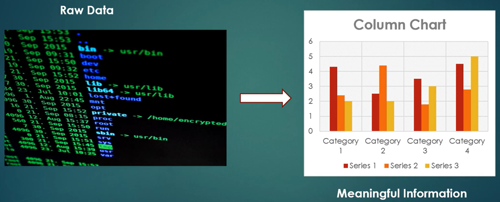
Data can be numbers, texts or images. Data is raw and has no meaning. Data is processed by humans and machines to derive information. Data is processed, organized, and structured to provide meaningful Information.

In IT, Data and Information are used interchangeably.
What is a table?

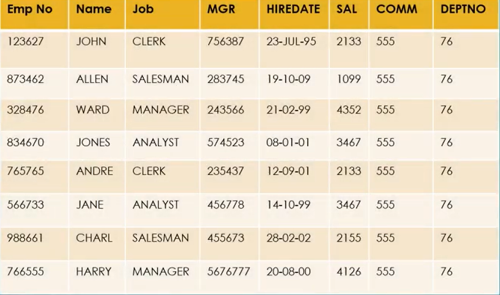
The data in a relational database is stored in database objects called tables. A table contains a group of associated data elements.  It is made up of columns and rows. These columns and rows contain fields.

A table is used for data storage in a relational database. A database can have one or more tables and these tables can be related using keys. The following is an example of an Employee table. It contains rows and columns pertaining to employees.
What is a field?

A table is made up of one or more fields.

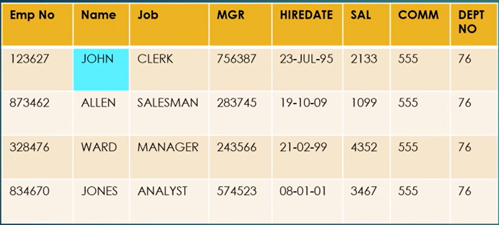
A field, also referred to as a column or attribute, stores specific information about a record in a table. In a table, a field or a column goes in the vertical direction and hold values of a particular type. For e.g. a field "Name" will only contain the employees names; it cannot be used to hold employees salary or phone number.
What is a Record or a Row?

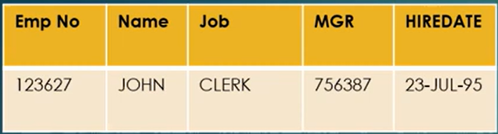
A record is also called as a row of data, made up of fields. For example, there are 4 records in the above EMPLOYEES table. A record or row is always horizontal and contains a specific set of information regarding the table. The following is a single row of data or record in this table with 5 fields–
What are Constraints?

Constraints are rules specified for the data in a table. Constraints are used to limit the type of data that can be stored or inserted into a table. It ensures the accuracy and reliability of data in the table. If a database operation violates a constraint rule, an error is generated.

The following constraints are applied to a table or to a column in a table:

  • Not Null: Specifies that this column cannot hold NULL values.

  • Primary key:  Specifies the column that uniquely identifies a row in the table. The identified columns must be defined as NOT NULL.

  • Unique: Specifies that values in the column must be unique.

  • Foreign key: Specifies that the values in the column must correspond to values in a referenced primary key or unique key column or that they are NULL.

  • Check: Specifies rules for values in the column.

  • Index: An Index is created on a column for faster data access.

What is a Null Value?

Null values get special attention in all database systems. A field with a NULL value is a field with no or missing value. Null value is basically nothing, not even a space or an empty string.

What is Data Integrity?

Data integrity refers to the overall accuracy, completeness and consistency of data. It makes sure that data in the database is reliable. Data integrity is enforced by applying the checks and constraints on the database.

The following types of Data Integrity rules are imposed on a database:

  • Entity Integrity: Each row in the table should be unique. There should not exist any duplicate rows in a table. This integrity rule is achieved by defining one or a group of columns as a Primary Key.

  • Referential Integrity: Defined on a key comprising of a column or set of columns in one table. It guarantees that the values in that key match the values in a key in a related table (the referenced value). This integrity rule is imposed by defining foreign key in a related table. Two tables are in relation if they have matching values in the primary key and foreign key columns.

  • Domain Integrity: This ensures that valid values are inserted into a given column. For e.g. Employee Name column cannot accept Salary values. This integrity rule is implemented by defining the appropriate data types for all the columns. Validity of entered values can also be maintained by defining proper constraints and checks.

  • User defined Integrity: is enforced by defining a set of user-defined rules, which do not belong to any of the other three categories.

Like
Chandraish Sinha

Chandraish Sinha is the Founder and President of Ohio Computer Academy, a leading institution committed to delivering high-quality IT education. With a passion for teaching and a belief in his company’s mission—Inspire, Educate & Evolve—Chandraish brings over 25 years of experience in the Information Technology industry.

Explore more of his work on his Amazon Author Profile.

0 Comments

Add Your Comment

Post a Comment

Required fields are marked *

✅ Thanks for adding your comment! It will appear after moderation.

0 Comments

Related Blogs
View All Blogs
How to install Oracle 11g and unlock sample databases
Read More
What are the 12 Codd rules of RDBMS
Read More
Primary Key and Foreign Key with example
Read More
Ohio Computer Academy - IT Training & Vocational Education in Dublin, OH

Registered with the Ohio State Board of Career Colleges and Schools — School Registration No. 2395

About Us
  • Contact Us
  • Our Story
  • Training Gallery
  • Reviews
  • Books
  • Greater Columbus Training Center
Trainings/Services
  • Course Categories
  • Learning Paths
  • Frequently Asked Questions
  • AI Advantage
Contact Us
  • Phone:+1 866-648-7284
  • E-mail: info@ohiocomputeracademy.com
  • Address:

    Dublin, Ohio
    5900 Sawmill Road, Suite # 150, Dublin, OHIO 43017 USA

Thank you
Failed
Free Training Courses
  • Computer Fundamentals for Beginners
  • MS Word for Beginners
  • Microsoft Excel for Beginners
AI Courses
  • Claude Basics
  • Claude Advanced
  • AI for Workplace Productivity
  • Prompt Engineering
  • Agentic AI Solutions
  • AI for Quality Control
Cloud Tech
  • DP-900 Azure Data Fundamentals
  • DP-100 Data Science on Azure
  • AWS Technical Essentials
  • AWS Cloud Practitioner
  • AWS Solutions Architect
DevOps
  • DevOps Essentials
  • DevOps with AWS
  • DevOps with Azure
Dashboarding/BI
  • Tableau Beginner
  • Power BI Beginner
  • Data Analytics with Excel
Database
  • Oracle SQL for Beginners
  • SQL for Analysts
  • SQL Server for Beginners
MS Office & Workplace Productivity
  • Workplace Digital Skills
  • Excel for Finance
  • Excel for HR
  • Excel Beginners to Advanced
  • Workplace Computer Skills
Learning Hub
  • Begin Your IT Career
  • Generative AI & Workplace Productivity Foundations
  • Claude AI Learning Path
  • Data Visualization Foundations
  • Data Analytics Career Path
  • AI for Business & Data Applications
  • Programming Foundations & Development Path

© 2026 Ohio Computer Academy. All rights reserved.

  • Privacy
  • Terms & Conditions