Ohio Computer Academy - IT Training & Vocational Education in Dublin, OH
All Courses
  • Free Training Courses
  • AI for Your Role
  • AI & Machine Learning
  • Cloud Tech
  • Data Science
  • DevOps
  • Dashboarding/BI
  • Database
  • WebDevelopment
  • Programming & Coding
  • MS Office & Workplace Productivity
  • QA & Test Automation
  • Professional & Career Development
  • Cyber Security

Courses

  • Computer Fundamentals for Beginners
  • MS Word for Beginners
  • Microsoft Excel for Beginners
  • Microsoft Azure for Beginners
  • AWS Cloud for Beginners
  • Oracle SQL Fundamentals
  • Tableau Fundamentals
  • Power BI Fundamentals
Explore All Programs

Courses

  • AI Essentials
  • AI for Administrative Professionals New Launch
  • AI for Managers & Team Leads
  • AI for Data Analytics & Power BI
  • AI for Software Developers
  • AI for Database & SQL Professionals
  • AI for Project Managers
  • AI for Marketing Professionals
  • AI for Sales Professionals
  • AI for HR Professionals
  • AI for Finance Professionals
  • AI for Customer Support Professionals
  • AI for QA & Test Engineers
  • AI for IT Support & System Admins
  • AI for Cybersecurity Analysts
  • AI for Job Seekers
Explore All Programs

Courses

  • Learn Claude Basics New Launch
  • Learn Claude Advanced New Launch
  • Applied Artificial Intelligence (AI) New Launch
  • AI for Workplace Productivity
  • Azure Fundamentals with AI
  • Advanced Microsoft Azure with AI
  • AI Implications for Business Strategy
  • Mastering ChatGPT & Generative AI Tools
  • Prompt Engineering
  • Agentic AI Solutions
  • AI Product Management
  • AI for Quality Control
Explore All Programs

Courses

  • AZ-900 Azure Fundamentals
  • DP-900 Azure Data Fundamentals
  • DP-100 Data Science on Azure
  • AWS Essentials
  • AWS Cloud Practitioner
  • AWS Solutions Architect
Explore All Programs

Courses

  • DP-100 Data Science on Azure
Explore All Programs

Courses

  • DevOps Essentials
  • DevOps with AWS
  • DevOps with Azure
Explore All Programs

Courses

  • Business Analytics: From Data to Insights New Launch
  • Power BI Advanced
  • Data Analytics with Excel
  • Tableau Beginner
  • Tableau Data Consumer
  • Alteryx & Tableau
  • Tableau Advanced
  • Tableau Certification prep
  • Power BI Beginner
  • Cognos Analytics
Explore All Programs

Courses

  • SQL Server for Beginners
  • SQL for Analysts
  • SQL Server Advanced
  • SQL Server T-SQL Programming
  • SSIS
  • Oracle SQL for Beginners
  • Oracle PL/SQL
  • Oracle SQL Advanced
  • Big Data with Hadoop: HDFS, MapReduce & Ecosystem Tools
  • MS Access
Explore All Programs

Courses

  • Angular Frontend Development
  • Spring 5 Framework
  • Full Stack Web Development
Explore All Programs

Courses

  • Learn Python
  • Python PCEP
  • Python PCAP
  • JavaScript & jQuery
  • Java Certification
  • Python for Data Science
  • Machine Learning with Python
Explore All Programs

Courses

  • Analyzing Data with Excel New Launch
  • Workplace Digital Skills
  • Excel Beginners to Advanced Trending Now
  • Excel for Finance
  • Excel for HR
  • Workplace Computer Skills
Explore All Programs

Courses

  • Selenium QA Automation (Java)
  • Selenium QA Automation (Python)
  • API Testing
  • QA Automation with Python (Advanced)
Explore All Programs

Courses

  • Scrum Master Certification
  • Lean Six Sigma Green Belt Certification
  • Business Analyst
Explore All Programs

Courses

  • Cyber Security Foundations for Beginners
  • Computer Networking for Cybersecurity
  • Windows & Linux Security Administration
  • Ethical Hacking & Penetration Testing
  • Artificial Intelligence (AI) in Cybersecurity
Explore All Programs
  • About Us
    • OCA Skill Sprint Method
    • Meet the Founder
  • Blogs
    • Career Building
    • AI / Machine Learning
    • MS Excel
    • Programming Essentials
    • Database
    • Cloud Computing
    • Tableau
    • Power BI
    • Web Development
    • Tips for Success
    • Qlik
    • Soft Skills
    • Technology
    • Business Intelligence Analyst
    • Message from the CEO
    • DATA ANALYST
  • TechCred
  • Find Your Training
  • Contact Us
Ohio Computer Academy - IT Training & Vocational Education in Dublin, OH


  • info@ohiocomputeracademy.com
  • +1 866-648-7284
  • Home
  • About Us
  • Blogs
    • Career Building
    • AI / Machine Learning
    • MS Excel
    • Programming Essentials
    • Database
    • Cloud Computing
    • Tableau
    • Power BI
    • Web Development
    • Tips for Success
    • Qlik
    • Soft Skills
    • Technology
    • Business Intelligence Analyst
    • Message from the CEO
    • DATA ANALYST
  • TechCred
  • Find Your Training
  • Contact Us
Find With Us
  • Home
  • Blogs
  • Power BI
  • Many-to-Many Relationships in Power BI: How to Avoid Them

Many-to-Many Relationships in Power BI: How to Avoid Them

Many-to-many relationships in Power BI often lead to ambiguous or inaccurate results when not modeled correctly. Although Power BI supports such relationships, they can introduce complexity, performance challenges, and filter confusion. This blog explains what many-to-many relationships are, why they may pose problems, and the best practices to avoid them when building clean and efficient data models.

New to Power BI? Get hands-on, step-by-step guidance in our Power BI for Beginners course. Start learning now.

Why Many-to-Many Relationships Occur in Power BI?

Many-to-many relationships in Power BI arise when both tables in a relationship contain non-unique values in the joining column. In such cases, Power BI cannot establish a clear “one” side, leading to ambiguous connections.

For example, if Table A and Table B both have multiple rows with the same OrderID, and neither column contains only unique values, Power BI recognizes this as a many-to-many scenario. These types of relationships are supported but often introduce complexity in filtering and reporting.

Issues with Many-to-Many Relationships in Power BI

While many-to-many relationships in Power BI offer flexibility, they come with several drawbacks:

  • Ambiguous Filter Propagation
    Filters may behave unpredictably, leading to incorrect totals or unexpected results in visuals.

  • Performance Overhead
    Complex joins and calculations may slow down reports, especially with large datasets.

  • Unreliable Aggregations
    Measures and totals can return incorrect values due to overlapping data paths.

Avoiding these issues often results in a more stable and performant data model.

Common Scenario: Duplicate Keys in Both Tables

Many-to-many relationships in Power BI typically occur when both tables involved contain duplicate values in the join column, and neither has a unique key. This makes it impossible for Power BI to enforce a one-to-many structure.

Example: Consider Orders and OrderDetails table. The structure of these tables is provided below:
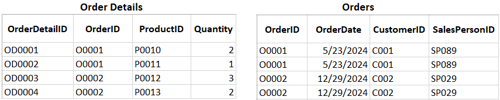
Table structure of Orders and OrderDetails showing duplicate OrderIDs that result in many-to-many relationships in Power BI 

The OrderDetails table contains duplicate OrderID values, which is expected — a single order can include multiple items. However, the Orders table also contains duplicate OrderID values, which is incorrect. Ideally, the Orders table should have unique OrderIDs, while the OrderDetails table can have multiple rows per order. Although this is a data quality issue, such scenarios can commonly occur in enterprise environments.

Result in Power BI

When Power BI tries to build a relationship on OrderID:

  • It detects duplicates on both sides.

  • It cannot enforce a one-to-many relationship.

  • A many-to-many relationship is automatically created, which may:

    • Inflate totals

    • Cause duplicate records in visuals

    • Lead to unexpected filter behavior

How to Resolve Many-to-Many Relationships in Power BI

To avoid issues caused by many-to-many relationships in Power BI, it’s essential to model the data with clear relationship paths and unique identifiers. Below are several best practices for resolving or preventing such situations:

1. Ensure Uniqueness in Lookup Tables

The table on the “one” side of the relationship should always have unique values in the key column (e.g., OrderID in the Orders table). Use Power Query Editor to remove duplicate rows or validate the uniqueness before establishing relationships.

2. Use Bridge Tables When Necessary

If a true many-to-many scenario exists (e.g., a product can appear in multiple orders and vice versa), create a bridge table that contains unique combinations of the shared key. This allows two one-to-many relationships to be established instead of one many-to-many.

3. Normalize the Data Model

Design the model using a star schema approach:

  • Fact tables (e.g., OrderDetails) should relate to dimension tables (e.g., Orders, Products, Customers) through unique keys.

  • Avoid connecting fact tables directly to each other when possible.

4. Review Relationships in Model View

Use Power BI’s Model View to confirm that:

  • The relationship direction is clear (preferably single-direction).

  • Cardinality is set as One-to-Many (1:*), not Many-to-Many (:).

  • Lookup tables appear on the correct side of each relationship.

Best Practice to Resolve Many-to-Many Relationships

In a well-structured model:

  • The Orders table should contain unique OrderID values.

  • The OrderDetails table may contain repeated OrderID values (as each order can have multiple items).

  • The relationship between Orders and OrderDetails should be One-to-Many (1:*) — avoiding many-to-many issues entirely.

Such a structure ensures clean filtering and accurate aggregations throughout the report.

In a well-structured model:

  • The Orders table should contain unique OrderID values.

  • The OrderDetails table may contain repeated OrderID values (as each order can have multiple items).

  • The relationship between Orders and OrderDetails should be One-to-Many (1:*) — avoiding many-to-many issues entirely.

Such a structure ensures clean filtering and accurate aggregations throughout the report.

Summary

Although many-to-many relationships in Power BI are supported, they are rarely the optimal choice. Avoiding them leads to better performance, clearer data flows, and more accurate reports. By structuring the model with clean keys, using bridge tables when needed, and maintaining lookup tables, Power BI reports become faster, more maintainable, and easier to troubleshoot.

Expand Your Power BI Skills

Interested in mastering Power BI beyond the basics?
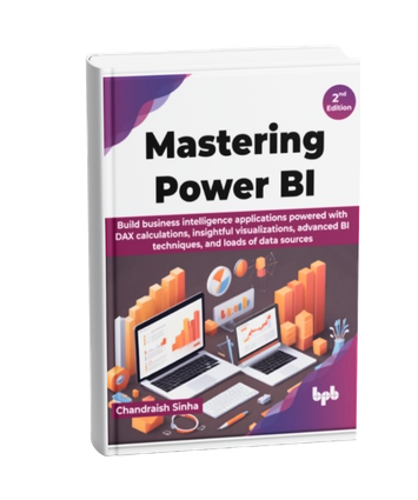
Mastering Power BI.png

Explore the comprehensive guide Mastering Power BI, Second Edition — packed with advanced data modeling, DAX techniques, and real-world reporting strategies.

If you’re looking for hands-on, instructor-led Power BI training, contact us today to learn more about upcoming courses and private training options.

Like
Chandraish Sinha

Chandraish Sinha is the Founder and President of Ohio Computer Academy, a leading institution committed to delivering high-quality IT education. With a passion for teaching and a belief in his company’s mission—Inspire, Educate & Evolve—Chandraish brings over 25 years of experience in the Information Technology industry.

Explore more of his work on his Amazon Author Profile.

0 Comments

Add Your Comment

Post a Comment

Required fields are marked *

✅ Thanks for adding your comment! It will appear after moderation.

0 Comments

Related Blogs
View All Blogs
Power BI Components
Read More
Connect to Excel Data Source in Power BI
Read More
Creating Scatter Chart in Power BI
Read More
Ohio Computer Academy - IT Training & Vocational Education in Dublin, OH

Registered with the Ohio State Board of Career Colleges and Schools — School Registration No. 2395

About Us
  • Contact Us
  • Our Story
  • Training Gallery
  • Reviews
  • Books
  • Greater Columbus Training Center
Trainings/Services
  • Course Categories
  • Learning Paths
  • Frequently Asked Questions
  • AI Advantage
Contact Us
  • Phone:+1 866-648-7284
  • E-mail: info@ohiocomputeracademy.com
  • Address:

    Dublin, Ohio
    5900 Sawmill Road, Suite # 150, Dublin, OHIO 43017 USA

Thank you
Failed
Free Training Courses
  • Computer Fundamentals for Beginners
  • MS Word for Beginners
  • Microsoft Excel for Beginners
AI Courses
  • Claude Basics
  • Claude Advanced
  • AI for Workplace Productivity
  • Prompt Engineering
  • Agentic AI Solutions
  • AI for Quality Control
Cloud Tech
  • DP-900 Azure Data Fundamentals
  • DP-100 Data Science on Azure
  • AWS Technical Essentials
  • AWS Cloud Practitioner
  • AWS Solutions Architect
DevOps
  • DevOps Essentials
  • DevOps with AWS
  • DevOps with Azure
Dashboarding/BI
  • Tableau Beginner
  • Power BI Beginner
  • Data Analytics with Excel
Database
  • Oracle SQL for Beginners
  • SQL for Analysts
  • SQL Server for Beginners
MS Office & Workplace Productivity
  • Workplace Digital Skills
  • Excel for Finance
  • Excel for HR
  • Excel Beginners to Advanced
  • Workplace Computer Skills
Learning Hub
  • Begin Your IT Career
  • Generative AI & Workplace Productivity Foundations
  • Claude AI Learning Path
  • Data Visualization Foundations
  • Data Analytics Career Path
  • AI for Business & Data Applications
  • Programming Foundations & Development Path

© 2026 Ohio Computer Academy. All rights reserved.

  • Privacy
  • Terms & Conditions